
Did you know you could celebrate Sologamy? Loving yourself could be revolutionary
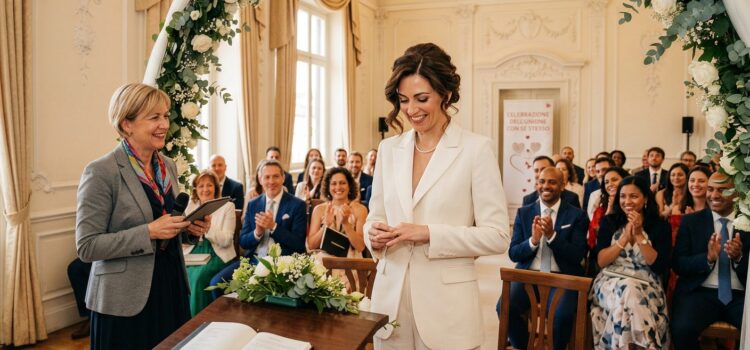
There may come a moment when you look in the mirror and decide it’s time to celebrate who you’ve become. Not with a partner, and not by exchanging rings with someone else, but by making a promise to yourself, in front of the people who matter to you.
A ceremony just for you?
It exists, and it’s called sologamy. It can be an intimate moment with just you and a celebrant, or a full celebration with family and friends. In Italy, as elsewhere in the world, it’s no longer seen as eccentric. It’s a rite of passage...
So, what is sologamy?
Sologamy, literally a “self-wedding”, is the choice to publicly celebrate a pact with yourself. It has no legal validity and isn’t recognised under civil law in any country, but its symbolic and psychological value is real.
Choosing sologamy doesn’t mean giving up on romantic love, and it isn’t a declaration of war on couples. It affirms that the most important relationship in your life is the one you have with yourself.
The word combines solo (from the Latin solus, “alone”) with -gamia (from the Greek gamos, “marriage”). It entered the international vocabulary between roughly 2014 and 2020, but the practice is older. The first documented ceremony dates back to 1993, when an American woman, Linda Baker, married herself at Lake Tahoe in front of seven witnesses.
A global phenomenon
Since the 1990s, sologamy has spread across the world in many different forms. The pandemic accelerated it, forcing many people into long periods of solitude and reflection and making the question “what is the most solid relationship I can build?” more pressing than ever.
Japan. The practice has deep roots here. Agencies such as Solo Wedding in Kyoto offer complete packages with the wedding dress, make-up, hairstyling, photographs, ceremony and reception. Japan also recorded about 500,000 traditional marriages in 2021, among the lowest figures in decades, which shows how far attitudes to marriage are shifting.
United States. Sologamy entered the popular imagination through Sex and the City (2003). In the episode “A Woman’s Right to Shoes” (Season 6, Episode 9), Carrie Bradshaw, played by Sarah Jessica Parker, imagines marrying herself as an ironic answer to the social pressure on single women. Since then the market has grown to include DIY ceremony kits, specialist agencies, and chapels with sologamy packages complete with photographer and celebrant.
India. In June 2022, Kshama Bindu celebrated the country’s first documented sologamy ceremony, with mehendi and haldi rituals reinterpreted as an act of self-commitment. It sparked a national debate.
South Korea. Marriage has reached an all-time low, and some companies have started giving employees who marry themselves the same leave as those who marry traditionally.
United Kingdom. Sophie Tanner married herself in Brighton in 2014 a public ceremony with bridesmaids. The trend is growing, mostly among women.
Italy. The first publicly known sologamist is Laura Mesi, a 40-year-old personal trainer who married herself in 2017 at a farmhouse in Vimercate in front of 70 guests. She wore a white dress, cut a five-tier cake, and even planned a honeymoon in Egypt. Around the same time, Nello Ruggiero held his own ceremony in Naples. In July 2023, visual artist Elena Ketra presented Sologamy.org in Rome, a digital performance supported by the Solares delle Arti Foundation, where people could marry themselves online, in person or remotely, and receive a certificate.
Spain. One of the first documented cases is Ana Isabel González, who married herself in 2010 in a three-day ceremony. In 2011, ten women publicly declared their self-marriage in a collective event in Bilbao.
France. In early 2025, Antoine Cheval held a sologamous ceremony, becoming one of the most widely cited male cases in Europe.
We found virtually no documented evidence of sologamy in Germany, the Netherlands, Scandinavia or Eastern Europe, with no known cases, specialist agencies or media coverage. The phenomenon is established or growing in the USA, Japan, India, South Korea, the UK and Italy, while in non-English-speaking continental Europe it remains sporadic.
Why would anyone marry themselves?
There are many, often overlapping reasons.
- Some people choose sologamy after a long relationship ends, as a way of reclaiming themselves.
- Others choose it to mark positive change in significant moments: turning 40, 50 or 60, retiring, moving house, or finishing a course of therapy.
- Some have simply never wanted to build their life around a partner, and want their choice to be recognised and celebrated.
A sologamous ceremony answers a deep human need: to be seen. Over the centuries we’ve created collective rites for almost every stage of life for couples, from engagement to marriage to anniversaries. Yet there is almost no ritual for those who choose to build a life without a partner. Sologamy fills that gap. It says: this journey deserves to be celebrated too, whether alone or in the company of those who care about you.
It doesn’t mean you’re hostile to couples, and it doesn’t mean giving up on being with someone in the future. It means no longer making the search for a partner the centre of your life and identity.
The role of a professional celebrant
A well-crafted sologamous ceremony needs the same care and storytelling sensitivity as a non-traditional wedding or funeral. That’s where a professional celebrant comes in.
As with any rite of passage, work on the ceremony starts long before the day itself. The celebrant meets the person and, through a series of conversations, explores their history, roots, formative moments and the values they want at the heart of the ceremony. From these exchanges emerges a portrait comprising details, anecdotes and episodes that capture their character, choices and experiences. It reflects the unique voice we each have, and that unique voice should be represented throughout the ceremony.
There are some key differences from a traditional wedding:
- One protagonist. The whole narrative revolves around one person, their story and their values. Instead of two lives intertwining, there is one to explore in depth.
- Vows addressed to yourself. Writing solo vows is a powerful exercise in focus. You have to ask what you truly want, and what you’re committing to for yourself and your future.
- Meaningful readings and music. A poem, a literary passage or a song is often at the heart of the ceremony, with texts speaking to the importance of freedom, authenticity and fulfilment.
- Active friends and family. Loved ones can read a passage, bring a symbolic gift or propose a toast. The ceremony becomes a moment of collective acceptance and recognition.
How is a sologamous ceremony structured?
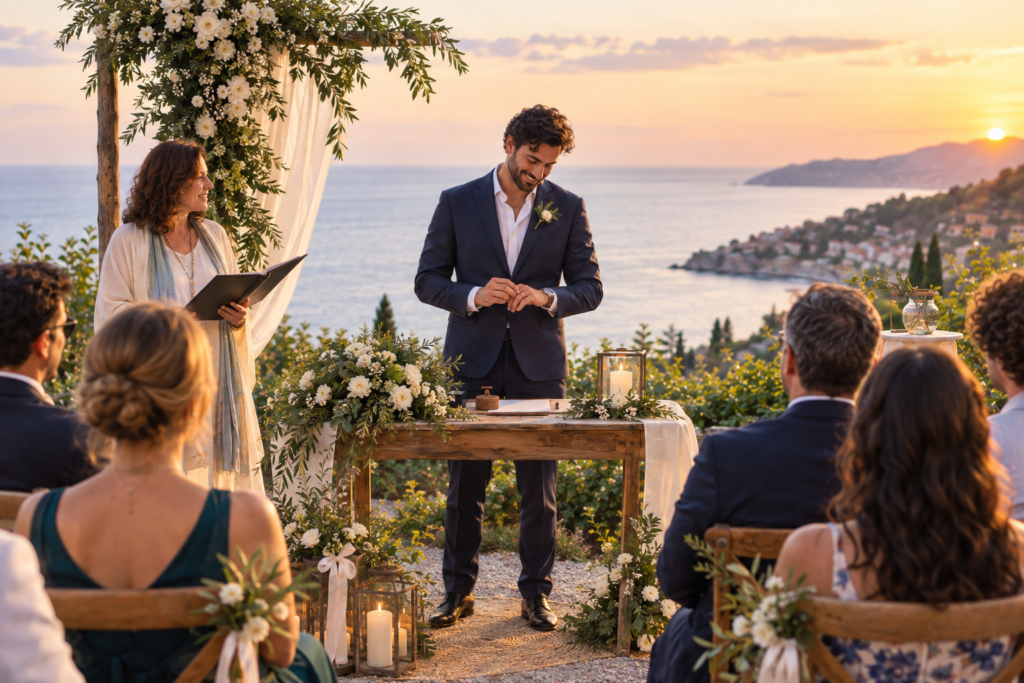
There’s no universal format, but twenty to thirty minutes is usually enough. As with any rite of passage, the key is to identify the heart of the ceremony, such as the vows the protagonist makes to themselves, and shape the ceremony so it flows naturally towards this core.
Here are the key moments:
- Welcome. The celebrant greets guests and opens the ceremonial space, briefly explaining what the ceremony is for.. Not everyone will know what sologamy is, and guests of different generations may have different expectations, so the tone of the opening matters.
- The life story. The celebrant tells the person’s story, in a style chosen together. It might follow their life chronologically, or move through revealing moments, with trips into the past and returns to the present, touching on childhood, life-shaping choices, cities lived in and values developed over time. This is usually the most moving part, and guests will recognise the person they love in the celebrant’s words.
- Guest contributions. A few close people, such as a friend, sibling or colleague, offer their good wishes or read a chosen text.
- Vows. This is the heart of the ceremony and its most intimate moment. In some cases, the celebrant helps the person find the right intentions and words, in others, the person writes them alone. Either way, they are promising things to themselves: acknowledging, thanking and committing.
- A symbolic ritual. The person puts on a new ring to mark the union, or holds a carefully chosen object that represents them, such as a flower, a stone or a book. The ritual should be simple, visible, authentic and uniquely meaningful to them.
- Closing and celebration. The celebrant closes with their best wishes, and toasts, music and dancing may follow. A sologamous ceremony is a serious act, but it isn’t over-serious, and it is often a preliminary for a great party.
Some call it narcissism. We call it courage.
Sologamy isn’t a stranger to criticism. Some see it as pure narcissism, a self-congratulatory moment that reflects the excesses of modern individualism, or even a gesture that belittles marriage.
Our experience as celebrants tells a different story. The people who come to us for a sologamous ceremony aren’t running away from people. They’ve often travelled a long and arduous path to reach a point where they recognise their own worth. They aren’t asking for attention, they’re asking for recognition, and offering this sincerely, through ritual, is one of the most human things there is.
A sologamous ceremony is a beginning, not an end.
As celebrants, we work by listening to and collaborating with the person who commissions the ceremony, whether the ceremony is a sologamy, a wedding, a funeral or any other occasion. We never use pre-written texts.
If you’re thinking about a sologamous ceremony for yourself, or you’re a celebrant who’d like to discuss this kind of ceremony with us, we’d love to hear from you.
Find a celebrant in Italy for your sologamy here
 English (UK)
  Italiano