
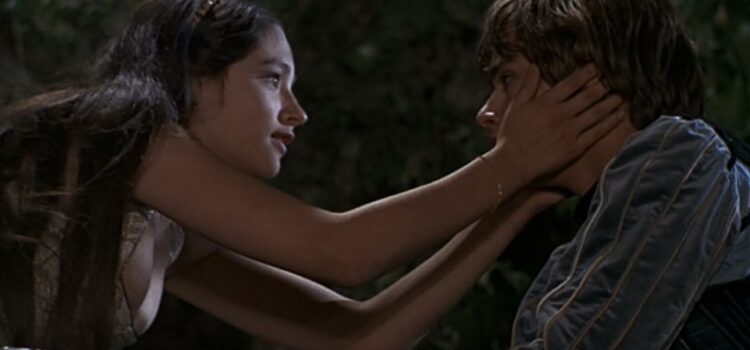
photo credit dal Film Romeo e Giulietta di Franco Zeffirelli
It's Valentine's Day, long live love!
Unforgettable love: a little game to remind us that all over the world, today people are celebrating love
Like every year on Valentine’s Day, red heart-shaped balloons (completely anti-ecological), and chocolate boxes (completely anti-diet) are everywhere, accompanied by declarations of love that are met with varying degrees of success.
But why stop at text messages, gift cards or red roses? It might be more fun, and more exciting, to remember love stories that have made hearts beat faster and stirred emotions, whether they be real or literary, tragic or comic.
Because every love story, even the shortest or simplest, has its distinctive character. It could be said that love is always the same, but anyone who experiences it is convinced they are the first and only ones. Every couple experiences their own story imbued with a sense of uniqueness.
So, let's remember a few First, some historical romances
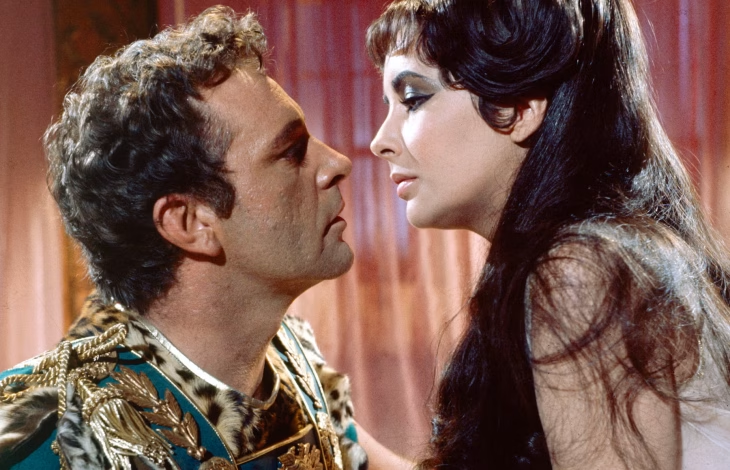
Cleopatra and Mark Antony
The story of Antony and Cleopatra is far from being a romantic fairy tale. Rather, it unfolds against a backdrop of political intrigue and military alliances formed to defeat a common enemy: Octavian. Between 41 and 30 BC, they were in a relationship that would lead first to defeat (Battle of Actium, 31 BC) and then to a double suicide. The independence of the Kingdom of Egypt died with them.
Thanks to the pens of writers such as Plutarch and Shakespeare, their love has become the stuff of theatre and myth.
Napoleon and Joséphine
Joséphine de Beauharnais (born Marie-Josèphe-Rose Tascher de La Pagerie) was Napoleon Bonaparte’s great love and first wife. The emperor had an intense and passionate relationship with her, firing off passionate letters, but things were complicated and the marriage ended in divorce. From the collection of letters from Napoleon to Joséphine (1796-1809): “I cannot live without you, Joséphine. Every thought I have is of you.“
Frida Kahlo and Diego Rivera
The love affair between Frida and Diego was both fascinating and complex. Their relationship involved the multiple ingredients of love, arguments, and passion. They separated and got back together. They nurtured one another, Diego committed to allowing Frida’s creative genius to take shape, without competition or jealousy. Their love is an example of creative intensity that transcends the boundaries of the ordinary.
In one of her letters to Diego, Frida writes: “Deep down, you and I love each other deeply, and that’s why we are able to endure countless adventures, slammed doors, curses, insults, complaints, and yet we will always love each other.”
Hadrian and Antinous
The Roman emperor Hadrian (76-138 AD) met the young Greek, Antinous (c.110-130 AD) probably in Turkey and fell madly in love with him. Their bond transcended the centuries, and Antinous became an icon of beauty and love.
Antinous was Hadrian’s favourite companion, following him on his travels and hunting trips, accompanying him everywhere until 130 AD, when, during a trip on the Nile, he died in mysterious circumstances. Even today, historians do not know what really happened.
Hadrian was devastated by his death and, to honour his beloved, founded the city of Antinopolis, deified Antinous by creating a cult, and ordered hundreds of statues, busts, and coins to be made bearing his face. Antinous thus became one of the most portrayed figures in Roman art.
Simone de Beauvoir and Jean-Paul Sartre
Simone and Jean-Paul, both philosophers and writers, were an intellectual and romantic couple. Both politically active, they lived in profound political and existential symbiosis and were united by a free and unconventional love, built on a fundamental pact based on full transparency and mutual freedom. From Letters to Sartre (1929-1980): “To love you is to think together and always walk side by side, never behind, never in front.”
Virginia Woolf and Vita Sackville-West
Virginia and Vita began their relationship in 1922. Their love affair lasted twenty years and was also an intellectual friendship between two key figures in the literary landscape of the 20th century.
Virginia’s love for Vita influenced her writing, and she was the inspiration for Virginia’s novel Orlando (1928), a work that spans the centuries and celebrates the multifaceted nature of Sackville-West. In her introductory essay to their correspondence, Always Write at Midnight: Letters of Love and Desire, Nadia Fusini points out that “the love between these two women never ends. They meet, they separate, they write to each other, they stop writing to each other, they start writing to each other again, and tenderness, friendship, and nostalgia always reemerge, and light and enchantment return.”
Now, some examples from literature
Romeo and Juliet (William Shakespeare, 1597)
This quintessential love story, which everyone, absolutely everyone, knows, so masterfully narrated by Shakespeare, has probably been staged millions of times. Over time, the story has become the archetype of perfect love opposed by society and family.
Shakespeare’s tragedy has been adapted musically by many: for example, by Tchaikovsky in his symphonic poem, in Prokofiev’s ballet and also by Kenneth MacMillan, in Gounod’s opera, in Bellini’s I Capuleti e i Montecchi, and in the famous 1957 musical West Side Story, which transports the two lovers – Tony and Maria – and their tragic story to New York’s Upper West Side.
Of course, cinema has also drawn heavily on the story of Romeo and Juliet. Suffice it to mention only the most famous films: the classic movie masterfully set in 16th-century Verona, directed by Franco Zeffirelli in 1968, and Romeo + Juliet, directed by Baz Luhrmann in 1996, which revisits the tragedy in a postmodern and frenetic key set in a fictional Verona Beach.
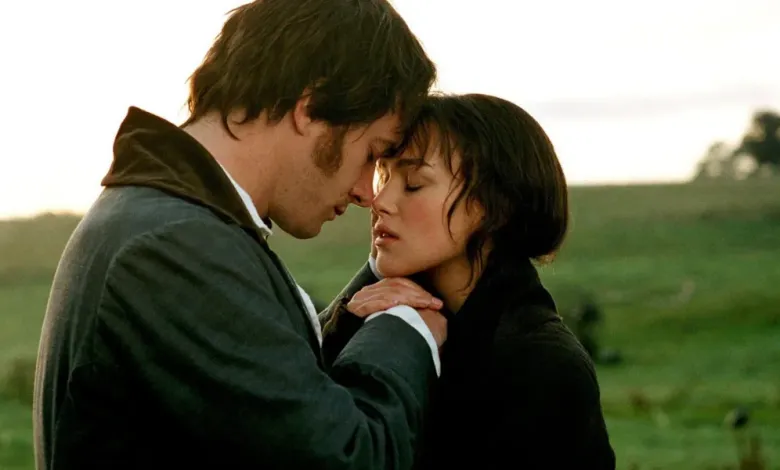
Elizabeth Bennet and Mr. Darcy (Jane Austen, 1813)
In the novel Pride and Prejudice, Jane Austen tells one of the most beloved love stories in literature. The union between the two protagonists is thwart with difficulty: Elizabeth is intelligent and brilliant, Darcy is rich and proud. It is a classic example of the enemies to lovers topos, for whom, in the end, love triumphs over conventions and misunderstandings and, overcoming social differences and their own prejudices, they get married.
Florentino Ariza and Fermina Daza (Gabriel García Márquez, 1985)
In the novel Love in the Time of Cholera, Márquez creates a tenacious love story between Florentino and Fermina. The story takes place in a lush Caribbean setting between the late 1800s and early 1900s. In order to fulfil his dream of love, Florentino waits fifty years for Fermina’s husband, Dr. Juvenal Urbino, to die.
The novel is a true hymn to perseverance, to love that overcomes every obstacle, that survives illness and the passage of time, that flows with the emergy of life.
It is also a tender and beautiful exploration of the ages of love: born as youthful passion, the feeling matures, transforms, and continues into old age.
The last sentence of the novel says it all: on the riverboat on which the two protagonists, now elderly, are finally together, when asked by the captain how long their comings and goings would last, “Florentino Ariza had had the answer ready for fifty-three years, seven months, and eleven days, nights included. ‘For the rest of our lives,’ he said.”
... and there’s more!
Of course, there are many other loves that have delighted us from the pages of other novels, such as the dark and overwhelming passion between Heathcliff and Catherine in Wuthering Heights (Emily Brontë); the tragic love story between Anna Karenina and Count Vronsky (Leo Tolstoy); Jay Gatsby’s love for Daisy Buchanan in The Great Gatsby (F. Scott Fitzgerald); and the love that challenges loyalty and honour between Tristan and Isolde or between Heloise and Abelard. Or the warrior-like and tragic love between Tancredi and Clorinda in Jerusalem Delivered (T. Tasso) and the love for Angelica that drives Orlando mad in Orlando Furioso (L. Ariosto).
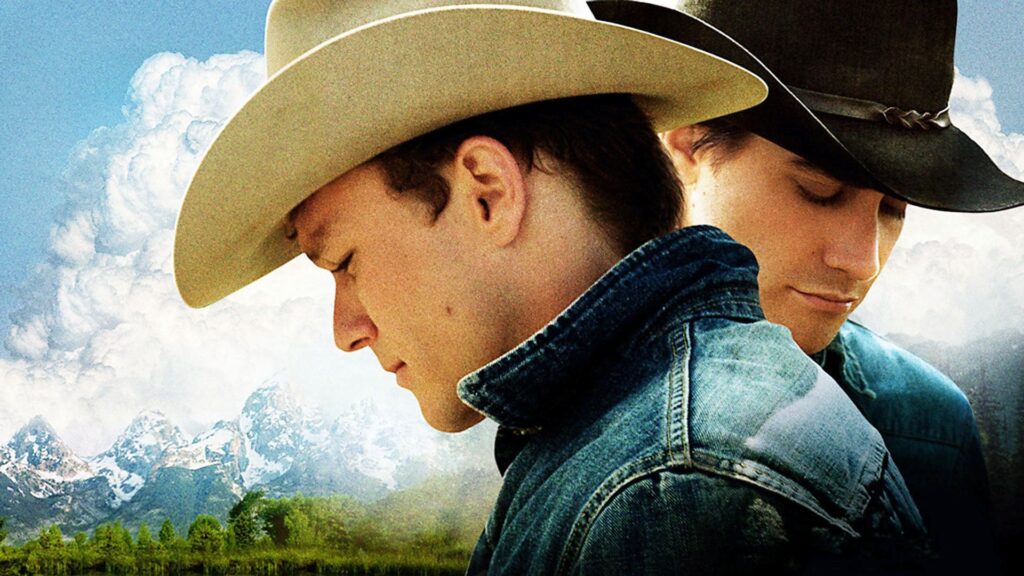
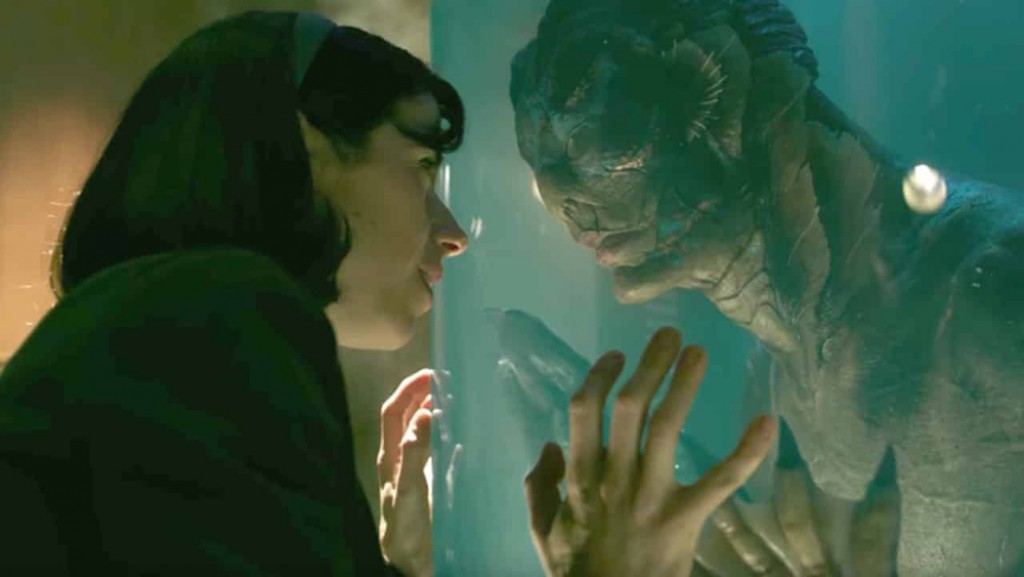
Let’s not forget, just for fun, some of the romantic films that have kept us glued to the screen, hanky in hand: from Gone with the Wind (1939) to Casablanca (1942); from Roman Holiday (1953) to Breakfast at Tiffany’s (1961); from Barefoot in the Park (1967) and Love Story (1970); from Annie Hall (1977) to Pretty Woman (1990); from The Bridges of Madison County (1995) to Titanic (1997) and Shakespeare in Love (1998); from Love Actually (2003) to Brokeback Mountain (2005) and from The Shape of Water (2017) to Call Me by Your Name (2017).
Every love is unique...
Whether it’s Cleopatra or Frida, Juliet or Florentino, whether they exchange poignant letters or voice messages, one thing is certain: love has a thousand forms, all equally memorable.
Every love story, big or small, powerful or quiet, dramatic or tender, has the power to make our hearts beat faster, to make us cry, to make us laugh, to nourish us throughout our lives or to stick in our memories, even after it is over, just like the notes and messages, the gifts that adorn our homes or end up at the bottom of a drawer.
As celebrants, we know very well how important your feelings, emotions, stories, dreams, words, and the uniqueness of your stories are to each of you.
As celebrants, our job is to gather everything you tell us about your love and to put it into words in a ceremony that is as personal and unique as you are as a couple!
After all, thanks in part to our ceremonies, your love becomes a chapter in the great love story of humanity.

And if you feel inspired, why not write a love letter today? What about proposing today? Start planning for a celebrant-led wedding today!
We are here to listen to you!
 English (UK)
  Italiano